
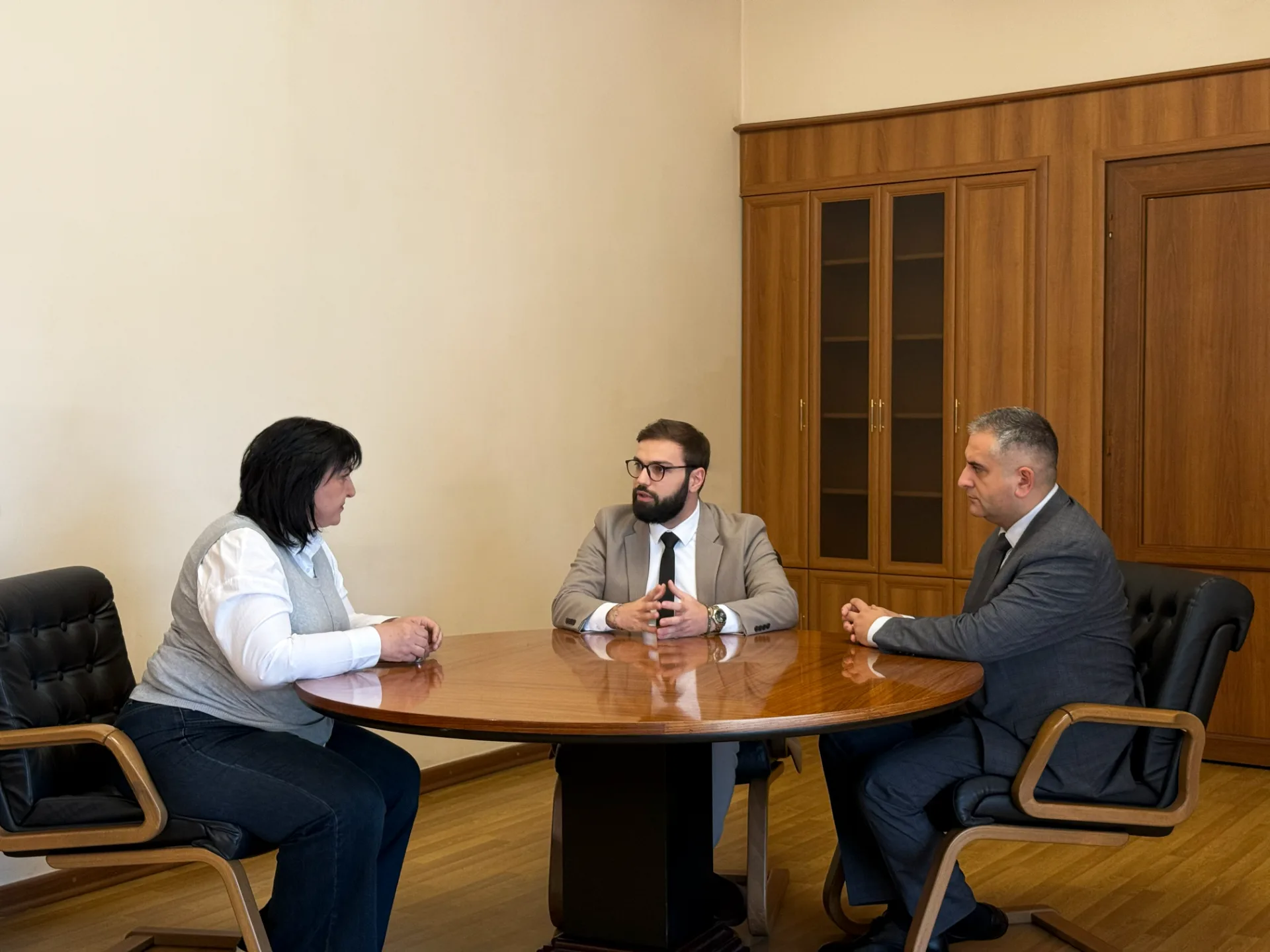
Hayk Babayan and Tigran Hovhannisyan presented the cooperation formats and recorded results within the framework of the Universal Health Insurance system on Mir TV
Tigran Hovhannisyan, Head of the Contracts, Methodology and Quality Management Department of the Universal Health Insurance Foundation, and Hayk Babayan, Director for Financial and Insurance Reimbursements, gave an interview to Mir TV Company, presenting the implementation process of the system, cooperation mechanisms, and the recorded financial and operational results.
According to Hovhannisyan, the Foundation is currently cooperating with around 460 medical institutions. This cooperation is built on unified principles and clearly defined mandatory and additional requirements that all partner organizations must meet. The process of joining the Foundation is organized under a public offer principle: medical institutions submit an acceptance application, complete the required forms, and present them to the Foundation. Applications are reviewed within a short timeframe, and in the absence of deficiencies, organizations are included in the list of partners, gaining the right to provide services to insured beneficiaries. A similar procedure applies to partner pharmacies, the number of which has reached approximately 480, ensuring wide accessibility of services across the country.
Hovhannisyan emphasized that one of the key advantages of the system is the freedom of choice for citizens. Beneficiaries can choose their preferred medical institution through an open referral, schedule appointments online, and apply to any partner organization.
Referring to financial indicators, Babayan noted that approximately AMD 40 billion in reimbursements were carried out in the first quarter of 2026. According to him, these results fully align with prior forecasts, which took into account population demand levels, the structure of diseases, the prevalence of chronic conditions, and the epidemiological situation.
In terms of utilization, the most active group is individuals aged 65 and above, which is due to both the higher frequency of illnesses and the need for more complex and costly treatments. According to Hayk Babayan, these figures also correspond to initial projections, as higher utilization was expected in this age group due to accumulated health issues. Utilization among younger age groups remains relatively lower.
Babayan also noted that, from a financial perspective, the main burden of the system is currently borne by the state. At the same time, the loss ratio remains within an acceptable range at around 60%, indicating the maintenance of financial balance within the system. Although costs are naturally higher in older age groups, they are mutually compensated across the system, ensuring the implementation of the principle of solidarity. Within the Universal Health Insurance system, each participant’s contribution is directed toward the overall well-being of society.